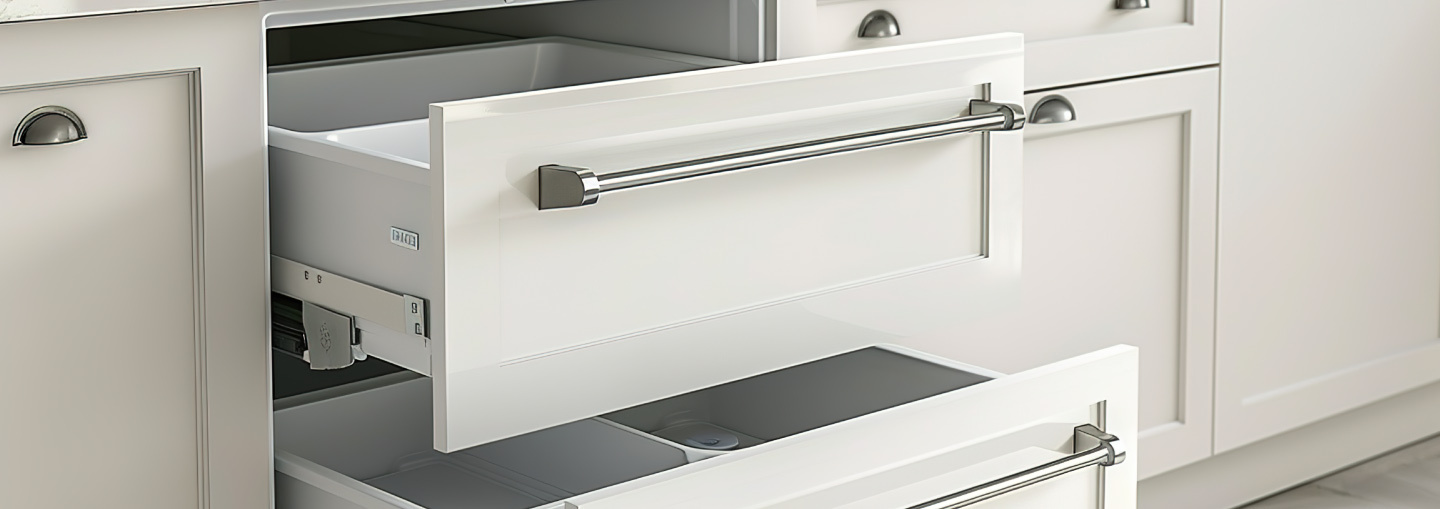
In interiors, we often talk about surfaces. The grain of wood, the softness of matte finishes, the way light settles on a panel at dusk. Hardware rarely enters the conversation until something goes wrong. A door that drops slightly. A drawer that resists, then gives in with a sound that feels louder than it should. These moments are small, but they shape how a space feels far more than most people expect.
Many clients are surprised to learn that what they perceive as “quality” is often not a material choice at all, but a mechanical one. Hinges, rails, handles, internal supports, these are the parts you do not see in photos, yet you experience them every single day. At Yanetti Furniture Atelier, this idea often becomes clear only after people begin using the furniture, when movement starts to matter more than appearance.
Why Hardware Is Felt Before It Is Seen
Unlike decorative finishes, hardware speaks through movement. You do not admire it from across the room. You touch it when you are tired, distracted, or in a hurry. That is precisely why it matters.
A well-made hinge allows a door to close with certainty, not speed. Good drawer rails glide without drama, even when loaded unevenly. A thoughtfully chosen handle feels instinctive in the hand. Poor hardware, by contrast, announces itself constantly. It clicks, shifts, pulls awkwardly, and demands attention in moments when you would rather think about something else.
Over time, this creates an emotional response. Spaces with reliable hardware feel calm. Those without it feel faintly irritating, even if the design is visually impressive.
Hinges: The Quiet Architecture of Doors
Hinges carry more responsibility than most people realize. They bear weight, absorb motion, and correct alignment hundreds of times a day. A standard wardrobe door may open and close tens of thousands of times over its lifetime. Each movement tests the hinge’s internal balance.
Modern concealed hinges are designed to do more than simply pivot. They manage speed, resistance, and final positioning. Soft-close mechanisms are not about luxury so much as control. They reduce impact stress on panels and frames, extending the life of the entire piece. In many long-term projects completed by Yanetti, hinge selection is finalized early, precisely because it determines how doors will behave years later.
Adjustment matters just as much. Quality hinges allow for fine tuning in multiple directions, up, down, in, and out. This makes it possible to realign doors as buildings settle or humidity shifts, without replacing the hardware itself.
What Separates Good Hinges From Forgettable Ones
While branding often dominates the conversation, performance comes down to engineering details.
- Internal spring quality and consistency
- Precision of the mounting plate
- Stable resistance across the hinge’s full movement
These elements determine whether a door still feels solid after years of use, or starts to sag quietly long before it should.
Drawer Rails: Movement as a Design Feature
Drawers reveal hardware more honestly than doors. You cannot disguise a rail that binds or flexes. The motion is either smooth or it is not.
High-quality drawer systems are built around weight distribution. Full-extension rails allow access to the entire drawer, not just the front portion. This prevents uneven loading, which over time stresses joints and warps drawer boxes.
Soft-close drawer rails engage later in the movement, catching the drawer gently and guiding it closed. When engineered well, this feels natural. When done poorly, it feels like resistance, as though the furniture is pushing back.
Why Load Ratings Matter More Than People Think
Load ratings are among the most practical indicators of rail quality. A kitchen drawer holding cookware requires a different system than a bedside drawer holding light items. Using under-rated rails rarely fails immediately. Instead, it degrades quietly. The drawer becomes uneven, then reluctant, then noisy.
This is why drawer planning is rarely generic. At Yanetti, rail systems are often selected after mapping how each drawer will actually be used, not how it appears in drawings.
Drawer Handles: The Most Touched Detail
If hinges and rails work behind the scenes, drawer handles operate at the point of contact. They are the part your hand meets first, often without conscious thought. Because of this, their role is both mechanical and sensory.
A well-designed handle offers clear grip without demanding effort. Its proportions guide the fingers naturally. Poorly chosen handles, even when visually striking, can feel sharp, slippery, or awkward over time. These discomforts accumulate quietly, turning daily use into a minor irritation.
Material choice matters here. Metal handles transmit temperature, stone feels cool and firm, wood softens the experience. Placement is equally important. A handle positioned even slightly off changes how the drawer moves and how the body responds.
Long-term comfort depends on:
- Adequate depth and finger clearance
- Softened edges and finish quality
- Secure fixing that prevents subtle movement
A handle that shifts under pressure undermines the feeling of solidity, even if everything else works perfectly.
Soft-Close Is Not a Universal Solution
Soft-close mechanisms are widely associated with quality, but they are not always appropriate. In some cases, especially with very light doors or shallow drawers, soft-close can feel unnecessary or awkward.
What matters is balance. Hardware should respond proportionally to the object it controls. Heavy doors benefit from controlled deceleration. Lightweight panels often feel better with simpler motion.
The best interiors make these decisions intentionally, rather than applying the same solution everywhere.
Climate, Use, and Quiet Endurance
Environmental factors shape hardware performance over time. Heat causes expansion. Humidity affects surrounding materials. Hardware that lacks adjustment range will eventually force compromise elsewhere, doors rubbing frames, drawers drifting out of alignment.
Daily use patterns matter just as much. A family kitchen experiences different stress than a guest room wardrobe. Thoughtful hardware planning anticipates this, rather than reacting to failure later.
When Details Truly Change Everything
Hardware is not an accessory. It is infrastructure. When chosen carefully, it supports the design without announcing itself. When neglected, it undermines even the most refined interiors.
The difference between furniture that merely looks good and furniture that feels right often comes down to what you cannot see, and what you touch without thinking. Hinges, rails, and drawer handles shape how we experience our spaces, one quiet movement at a time.
That is where true quality lives, not on the surface, but in the details that work silently in the background, day after day.