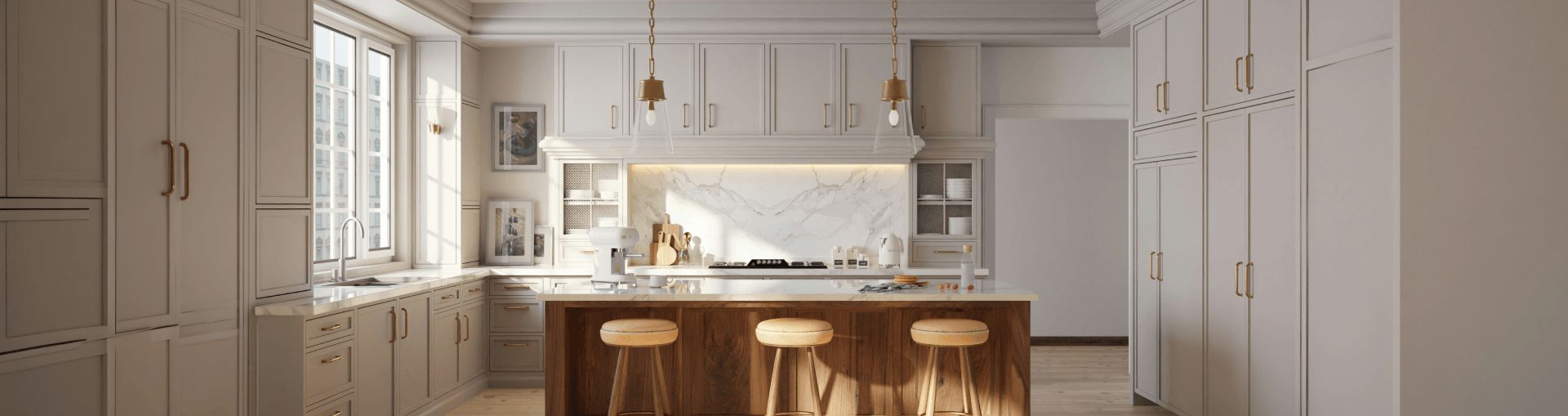
Two custom joinery projects can look nearly identical on installation day. Same wood tone, same handles, same clean lines running along a wardrobe wall or a kitchen island. Come back in three years and the difference is obvious. One unit still closes with the same quiet resistance it had on day one. The other has a door sagging at the corner, a drawer that sticks in humid weather, and a shelf bowing under weight it was never built to hold.
None of that comes from the finish. It comes from decisions made weeks before anyone chose a paint colour or a veneer pattern, decisions made in a workshop, on a site survey, during manufacturing most homeowners never see. Custom joinery is one of those categories where the visible ten percent gets all the attention and the invisible ninety percent does all the work.
Precision Starts Before Manufacturing
A joinery project usually succeeds or fails on the measuring tape, long before it reaches the workshop floor. Walls are rarely straight. Floors are rarely level. Ceilings drop and rise by a few millimetres from one end of a room to the other, and nobody notices until a fitted wardrobe or a run of kitchen cabinetry tries to sit flush against them.
Experienced joinery manufacturers, including Yanetti Furniture, typically validate measurements and technical drawings before production begins, and it’s common to return to a site more than once when something doesn’t add up on paper. Laser tools have made measuring far more accurate than it used to be, but a laser only helps if someone actually checks a wall’s irregularities, a floor’s level changes, and a ceiling’s deviation at several points rather than one corner.
What a Proper Site Survey Actually Checks
- Wall straightness at multiple heights, not just floor level.
- Floor level across the full run of the unit, corner to corner.
- Ceiling deviation, since a drop of even five millimetres changes how a top panel needs to be cut.
- Door and window reveals that might interfere with a planned unit depth.
- Services behind the wall, sockets, pipework, that affect where a panel can be fixed.
Manufacturing tolerances get decided at this stage too. A cabinet built for a wall that’s slightly out of square needs adjustable panels, scribe strips, or filler pieces designed in from the start, not added on site as an afterthought. Skip that step and the gaps get filled with sealant later. That’s a workaround, not a fix.
The Quality Nobody Sees
Open a cabinet door and most people look at the shelf and the finish inside it. Professionals look somewhere else entirely: how the carcass is built, how the joints are reinforced, and how weight actually moves through the structure once it’s loaded.
Take shelf support. Two shelves can look identical and behave completely differently depending on whether they’re held by dowels, cam locks, or hidden metal connectors, and depending on the panel thickness sitting behind them. Load distribution matters even more in taller units, bookcases, dressing rooms, and larger kitchen pantries, where weight needs to travel down through the sides of the cabinet instead of resting entirely on a single shelf pin.
Structural Details That Separate Durable Joinery from Short-Lived Joinery
- Reinforced corner joints on tall or heavily loaded units, not just glue and pins.
- Shelf pins rated for the actual weight they’ll carry, not a generic default.
- Panel thickness that increases with shelf span, since a shelf spanning 900mm needs more support than one spanning 400mm.
- Hidden connectors placed to distribute load through the carcass sides, not just the back panel.
- Fixing points anchored into structural material behind the wall, not just plasterboard.
Edge finishing gets overlooked constantly. A properly finished edge protects the panel core from moisture and daily wear. A poorly finished one swells or chips within a year or two, usually right where hands touch it most.
One detail that’s frequently missed is how fixing systems anchor a unit to a wall. A wardrobe fixed only into plasterboard, not into a structural point, can shift slightly over time. Doors that were perfectly aligned at handover slowly stop being aligned, even though nothing about the manufacturing changed.
Hardware Defines Daily Experience
Nobody remembers which hinge brand sits on a cabinet they love. They notice immediately when a drawer starts dropping at the front or a soft-close mechanism stops closing softly. Hardware is the part of custom joinery touched every single day, so it wears out first, and it reveals quality gaps well before anything else does.
Hinges vary a lot in cycle rating, the number of open-close movements they’re rated to survive before performance starts to degrade. Drawer runners work the same way. A cheap runner can feel perfectly fine on day one and start sticking within two years, especially once it’s carrying real weight.
Where Hardware Quality Shows Up First
- Hinges – cycle rating determines how long a door keeps its soft, even close before it starts to sag or slam.
- Drawer runners – load capacity and full-extension quality decide whether a drawer stays smooth once it’s actually full.
- Lift systems – gas struts on overhead cabinets lose lift strength over time if they’re undersized for the door weight.
- Pull-out storage – repeated use exposes weak telescopic rails within the first year, not the tenth.
- Adjustment mechanisms – three-way adjustable hinges allow doors to be realigned later, which matters once a building settles.
Lift systems on overhead cabinets, pull-out storage in kitchens, adjustment mechanisms in wardrobes, all of it depends on hardware quality far more than on how the cabinet looks from across the room. This shows up after years of daily use, not at handover. That delay is exactly why hardware is one of the easiest places for a project to get quietly downgraded without a homeowner ever noticing during the sales conversation.
Material Selection Is More Than Appearance
MDF, plywood, veneer, laminate, lacquer, engineered panels—none of them is universally better than the others. The real mistake is choosing a material based on how it looks in a showroom sample instead of how it performs in the specific application it’s going into.
Matching Material to Application, Not Just Appearance
- MDF – Takes paint finishes well and machines cleanly. Strong for painted cabinetry, weaker around constant moisture unless it’s moisture-resistant grade and properly sealed.
- Plywood – Carries screws and structural loads better. Common in load-bearing carcasses or shelving meant to hold real weight.
- Veneer – Gives a natural wood look with more dimensional stability than solid timber, though the substrate underneath still decides how well it holds up.
- Laminate – Resists scratches and daily wear. Useful in high-traffic kitchen cabinetry.
- Lacquer – Looks sharp and modern but shows fingerprints and minor scuffs more readily, worth considering in a house with kids or pets.
The right furnishing materials aren’t purely aesthetic decisions. They’re application decisions that happen to also affect how something looks.
Joinery That Fits the Building
Custom joinery starts to look genuinely expensive not when the materials are expensive, but when it stops reading as furniture placed inside a room and starts reading as something the room was built around. That effect comes from architectural detailing most people can’t name but notice instantly.
Shadow gaps, the thin recessed lines between a panel and a wall or ceiling, remove the need for visible trim and keep transitions clean. Reveals and flush installations mean handles, seams, and joints line up with door frames, skirting, or adjacent wall panelling instead of fighting with them.
Wall panel integration, where joinery blends into a wider millwork scheme instead of standing alone, needs real coordination between the joinery manufacturer and whoever is handling the architectural finishes. That coordination doesn’t happen by accident.
This approach is common among established companies such as Yanetti Furniture, where manufacturing precision is prioritised long before installation, since architectural alignment only works if the cabinetry is built exactly to the tolerances the site survey identified in the first place.
Installation Determines the Final Result
Even flawlessly manufactured joinery can underperform if the installation is rushed. Levelling is usually the first thing to go wrong under time pressure. A cabinet out of level by a few millimetres shows it in every door and drawer for the entire life of the unit.
What a Careful Installation Actually Involves
- Levelling checked at multiple points across a run, not just at each end.
- Alignment between adjacent units so seams read as one continuous line.
- Final hinge and runner adjustment done after the unit is fixed in place, not before.
- Silicone and sealant work finished cleanly, without smearing onto adjacent surfaces.
- Protection of floors and surrounding finishes throughout the fitting process, not just at the end.
Alignment between adjacent units matters just as much, especially in kitchens and dressing rooms where several cabinets need to read as one continuous line rather than separate boxes pushed next to each other. Final adjustment, the small tweaks to hinges and runners once a unit is fixed in place, gets skipped constantly on lower-quality installs, and it’s usually what separates doors that close evenly from doors that don’t.
Longevity
What separates joinery that still looks new after ten years from joinery that starts showing problems within two or three isn’t visible on day one. It’s the combination of accurate site measurement, a structurally sound cabinet build, hardware chosen for durability rather than price, materials matched to their actual application, and an installation carried out with patience instead of speed.
High-quality custom joinery gets defined long before the visible finish goes on. Precision planning, engineering, material selection, hardware, manufacturing, and installation all shape how the joinery performs over years, not just how it looks on the day it’s fitted. Finishes create the first impression. Hidden details decide whether that impression still holds up a decade later.