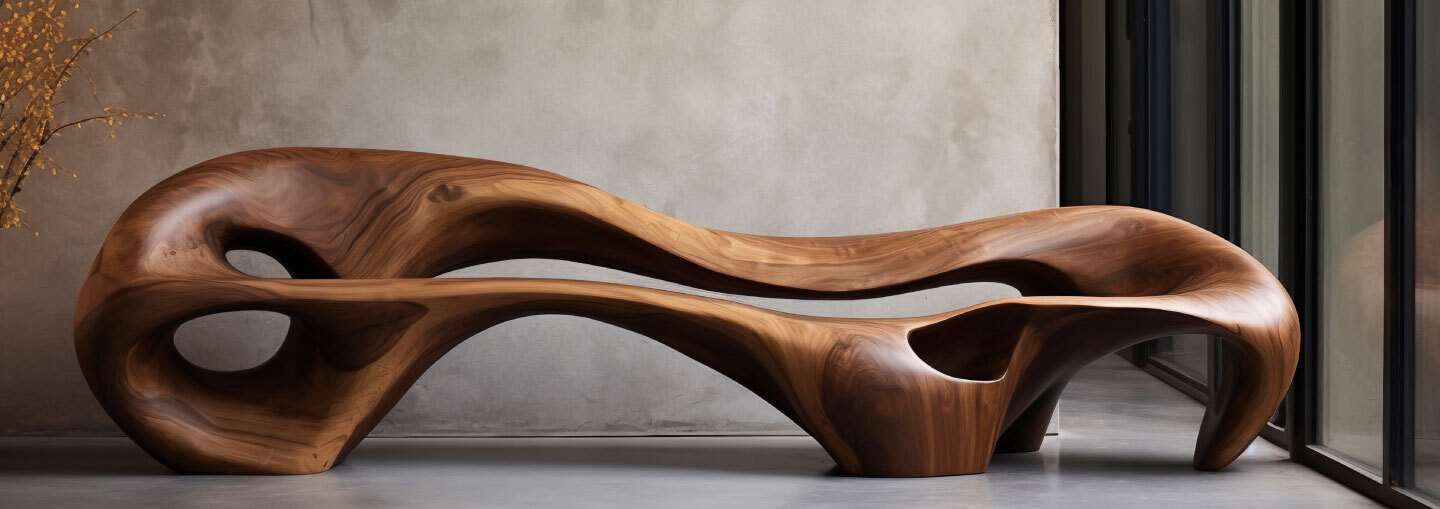
Luxury furniture is often discussed as if it were about looks. Shape, colour, silhouette. In practice, material choice carries far more weight. It determines how a piece behaves in daily life, how it reacts to climate, how it ages, and whether it will still make sense decades from now.
In the upper tiers of furniture design, expensive materials are rarely chosen for drama. They are chosen because they resist shortcuts. They slow production. They expose mistakes. They demand a level of care that mass manufacturing cannot accommodate.
That friction is part of their value.
What Makes a Material “Luxury” in Furniture
Luxury, in furniture terms, is not defined by rarity alone. Many rare materials are unsuitable for use at scale, or degrade too quickly to justify their cost. What elevates a material is a specific combination of qualities.
First, longevity. A luxury material must hold structural and visual integrity over time. Not months, but decades. Second, behaviour. It should respond predictably to touch, temperature, and use, even if that response includes visible aging. Finally, skill dependency. The material should require experienced hands to work with it properly.
If a material can be processed without consequence by an inexperienced workshop, it rarely remains luxury for long.
Rare Woods and the Cost of Growth
Ebony, Rosewood, Sandalwood
Hardwoods sit at the centre of luxury furniture history, largely because trees do not respect production schedules. Ebony, for example, grows slowly and irregularly. Its density dulls tools quickly. Its colour cannot be corrected if the cut is wrong. Waste is expensive.
Historically, ebony was reserved for sacred objects, instruments, and royal furniture. That association persists, not through marketing, but through difficulty. Working with it still requires patience most workshops cannot afford.
Rosewood occupies a more complicated position. Once common enough to be used generously, it is now heavily regulated. Responsible sourcing has narrowed availability, which has changed how it appears in furniture. Large surfaces are rare. Veneers, accents, and structural elements are more common, used deliberately rather than decoratively.
Sandalwood, by contrast, is valued as much for scent as for structure. Its use in furniture is subtle. Drawer interiors, hidden panels, ceremonial pieces. It is not a material that announces itself, and that restraint is part of its appeal.
In all cases, cost is tied directly to time. These trees cannot be replaced on demand.
Metals That Age, Not Just Shine
Gold, Brass, Bronze
Precious metals in furniture are often misunderstood. Solid gold furniture exists, but it is more symbolic than functional. In practice, gold appears as leaf, inlay, or plating, applied with precision and restraint.
More commonly, luxury furniture relies on brass and bronze. These metals are valued not for brightness, but for how they change. Their surfaces soften. Oxidation deepens colour. Touch leaves evidence.
What increases cost here is not the metal itself, but control. Custom alloys are often developed to achieve specific tones or aging patterns. Finishes are tested repeatedly. Patinas are stabilised by hand.
A rushed finish on brass looks cheap very quickly. A careful one improves with time.
Stone as Structure and Surface
Marble, Onyx, Quartzite
Stone introduces a different set of constraints. Weight, fragility during cutting, and unpredictability all raise costs. A marble slab may look consistent from a distance, but once cut, flaws appear. Cracks, voids, weak points.
For furniture, only a fraction of quarried stone is usable. The rest becomes waste. That inefficiency is built into the price.
Onyx and quartzite push this further. Their hardness or translucency demands specialised equipment and reinforcement. In tables or cabinetry fronts, stone must be engineered as carefully as it is selected.
Semi-precious stones, such as malachite or lapis lazuli, are rarely used as solid surfaces. Instead, they appear as veneers or mosaics. Each piece must be oriented by hand. Colour variation cannot be ignored or corrected later.
Stone records use permanently. That is part of its appeal, and part of the risk.
Organic Materials That Resist Uniformity
Full-Grain Leather, Shagreen, Natural Fibres
Leather becomes expensive when nothing is hidden. Full-grain hides show scars, variation, and irregular thickness. Upholstering with them takes longer. Mistakes cannot be disguised.
Shagreen is even less forgiving. Each skin is small. Each surface uneven. Joining them seamlessly requires experience that few workshops maintain.
Other organic materials appear sparingly in luxury furniture. Horn, parchment, bone. They are not fragile, but they are sensitive. Light, humidity, and temperature all matter. Their use demands restraint and understanding.
These materials are costly because they refuse uniformity. They make every piece slightly different.
Finishes That Multiply Labour
Some of the most expensive elements in luxury furniture are not immediately visible. Traditional lacquer, applied in dozens of layers, builds depth slowly. Each layer must cure fully. Any contamination means starting over.
Marquetry and advanced veneer work stretch rare materials further, but increase labour exponentially. Alignment, grain direction, and adhesive choice all matter. A small error compromises the entire surface.
In many workshops, finishing consumes more time than construction. It is where craftsmanship is most exposed.
How Materials Age and Why It Matters
Material choice determines how furniture lives. Dense woods resist wear but react strongly to humidity changes. Stone tolerates heat but reacts to acids. Leather softens, darkens, and stretches where used most.
Luxury materials do not stay static. They change. That change is predictable if the material is understood, and disastrous if it is not.
Climate plays a quiet role here. Materials that perform well in temperate environments may struggle in humidity or extreme dryness. Experienced designers adapt thickness, joinery, and finishes rather than abandoning the material.
Why These Materials Remain Exclusive
Modern alternatives can mimic appearance. Engineered woods can imitate grain. Composite stone can resemble marble. What they cannot replicate is behaviour over time.
Luxury materials resist standardisation. Their variability slows production. Their imperfections demand judgment. Their cost reflects not only scarcity, but the human attention they require.
In furniture, true luxury is not about excess. It is about commitment. To materials that do not bend to convenience, and to objects designed to justify their presence over many years, not just at first glance.