Dubai has always moved faster than its furniture. Towers rise quickly, neighbourhoods shift identities, lifestyles recalibrate, and interiors are left to catch up. For years, furniture in Dubai homes tried to compensate for that speed by being expressive, sometimes too expressive. Bold finishes, heavy forms, pieces chosen to impress rather than to settle.
By 2026, that impulse is fading.
What is emerging instead is a quieter, more deliberate approach to furniture. One shaped less by display and more by use. Less by trend forecasting and more by what actually survives daily life in this climate, in these floor plans, with these habits.
Many designers describe it as a correction rather than a revolution. Homeowners, on the other hand, usually notice it only after moving in.
How Climate and Light Quietly Dictate Furniture Design
Dubai’s climate does not announce itself inside a home, but it leaves marks over time. Strong daylight, long cooling cycles, fine dust, and fluctuating humidity quietly test every surface. Furniture that performs well here is rarely accidental.
In 2026, furniture choices increasingly reflect that reality. Highly reflective finishes are still used, but with restraint. Gloss appears in controlled zones, not across entire rooms. Matte and satin surfaces dominate, partly for aesthetics, partly because they age more evenly under constant light exposure.
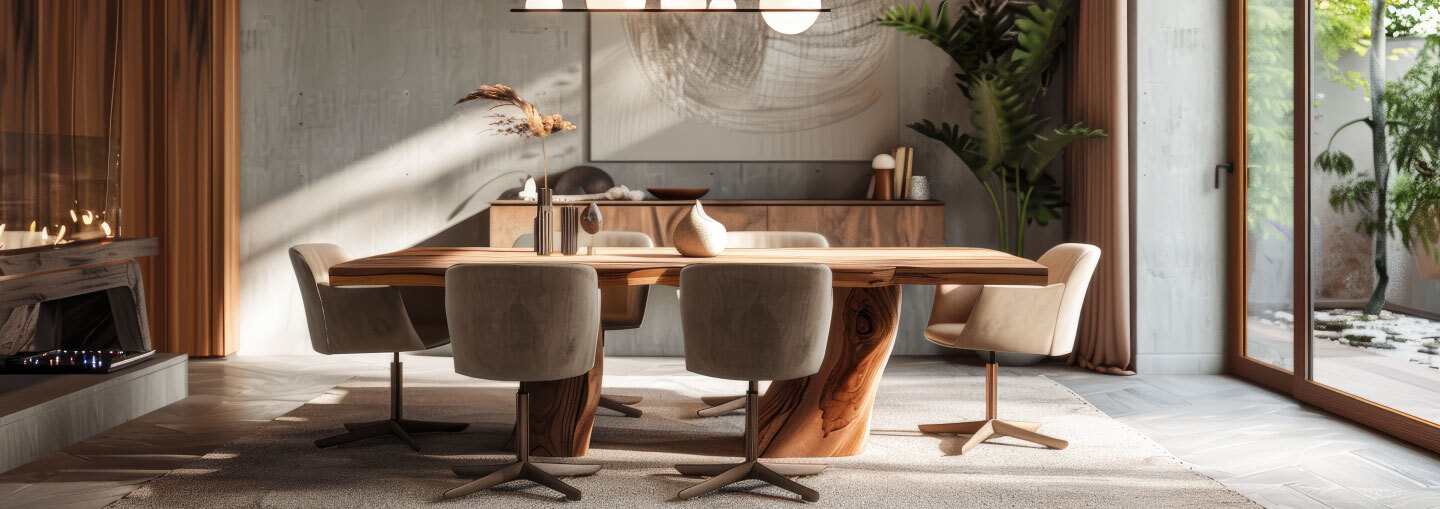
Light itself has become a design constraint. Large windows, common even in modest apartments, flatten heavy furniture visually. Bulky silhouettes absorb light in ways that make spaces feel smaller than they are. Designers now favour slimmer profiles and lifted forms, pieces that allow light to move through a room rather than stopping it.
It is not minimalism, at least not in the strict sense. It is adaptation.
Material Choices Are Becoming Less Decorative, More Predictable
One of the clearest furniture trends in Dubai for 2026 is the move toward materials that behave consistently. Not materials that impress on day one, but materials that look acceptable on day nine hundred.
This is where material honesty comes in. Finishes that pretend to be something else are losing ground. Instead, materials are allowed to read clearly, even plainly.
Wood tones are warmer but quieter. Natural grain is visible, though rarely exaggerated. Stone surfaces are thinner and more controlled, often engineered rather than solid. Metals appear brushed or softened, avoiding sharp reflections that feel harsh under intense daylight.
In practice, this means fewer surprises. Fewer surfaces that suddenly look tired. Furniture that changes slowly, rather than failing all at once.
Modern Furniture Is Blending Into Architecture
By 2026, modern furniture in Dubai is no longer treated as a separate layer placed inside architecture. It is increasingly designed to sit within it.
Storage is the most obvious example. Wardrobes, media units, and wall systems are aligned with ceiling lines and structural grids. Handles disappear. Panels read as planes rather than objects. The furniture feels built-in, even when it technically is not.
This architectural approach solves several problems at once. It reduces visual clutter. It improves spatial flow. It also removes the sense that furniture must constantly be rearranged or replaced.
In apartments, especially, this integration creates calm. Rooms feel finished, even sparsely furnished ones. In villas, it prevents scale from becoming overwhelming.
Materials Gaining Ground in 2026 Homes
While design language varies, certain materials appear repeatedly across Dubai interiors heading into 2026. Their popularity is less about fashion and more about reliability.
Some of the most common include:
- Engineered wood panels designed for dimensional stability in controlled indoor climates
- Textured laminates that soften surfaces without demanding delicate care
- Sintered stone and porcelain slabs, chosen for heat tolerance and ease of cleaning
- Matte coatings that reduce glare and visible wear under strong lighting
These materials are not experimental. They are selected precisely because they remove uncertainty from everyday living.
Minimalist, Modern, and Custom, Not the Same Thing
The language around furniture styles has become blurry, especially online. Minimalist, modern, and custom are often used interchangeably, but in practice they describe different priorities.
Minimalist furniture focuses on reduction. Fewer lines, fewer materials, fewer contrasts. In Dubai, this works best in smaller homes where visual clarity directly improves comfort.
Modern furniture is more flexible. It allows for material richness and stronger forms, but still relies on proportion and balance. This approach suits open-plan apartments and villas where furniture must anchor space without dominating it.
Custom furniture is not a style at all. It is a response. It adapts to ceiling height, wall depth, circulation paths, and storage demands. In 2026, many homeowners choose custom solutions not to stand out, but to eliminate compromise.
Why Custom Furniture Keeps Expanding in Dubai
Custom furniture has steadily moved from luxury option to practical solution. The reason is simple. Many Dubai homes are designed efficiently, but not always intuitively furnished.
Standard furniture rarely aligns perfectly with real layouts. Slight mismatches accumulate. Storage feels insufficient. Proportions feel off. Custom furniture resolves these issues quietly.
Designers often note that clients rarely ask for custom furniture directly. They ask for calm. For less clutter. For homes that feel easier to live in. Custom solutions deliver that without calling attention to themselves.
Softer Forms Without Losing Structure
Another subtle shift in Dubai furniture trends for 2026 is the softening of form. Straight lines still dominate, but edges are eased. Corners curve gently. Upholstery looks more relaxed, though not casual.
This reflects how homes are now used. Furniture must support work, rest, and social life without changing character. A dining chair may host a laptop for hours. A sofa might become a workspace by afternoon.
Comfort has become more measured. Deep, overly soft seating is less common. Support, longevity, and posture matter more than immediate softness.
Furniture Designed to Age Quietly
Perhaps the most important change in furniture thinking is the emphasis on aging. Homeowners are increasingly asking how furniture will look after years, not weeks.
This has led to fewer dramatic contrasts and more layered textures. Color appears through materials rather than surface finishes. Visual interest is created by depth, not decoration.
Designers often describe successful furniture as something that settles into a home. It becomes part of the background without disappearing. It does not demand attention, but it also does not fade.
Principles Designers Rely On
Across Dubai apartments and villas, certain professional principles appear again and again, regardless of style.
Furniture should respond to light, not compete with it.
Materials must tolerate heat, cleaning, and daily use.
Proportions should match architecture, not showroom displays.
Storage should be integrated wherever possible.
These are not trends. They are responses to lived experience.
Looking Ahead to 2026
Dubai furniture trends in 2026 are defined less by novelty and more by resolution. Interiors are becoming calmer, materials more predictable, and furniture more integrated into the structure of daily life.
For homeowners, this brings clarity. Good furniture is no longer about labels or categories. It is about fit, performance, and how naturally it supports the way a home is actually used.