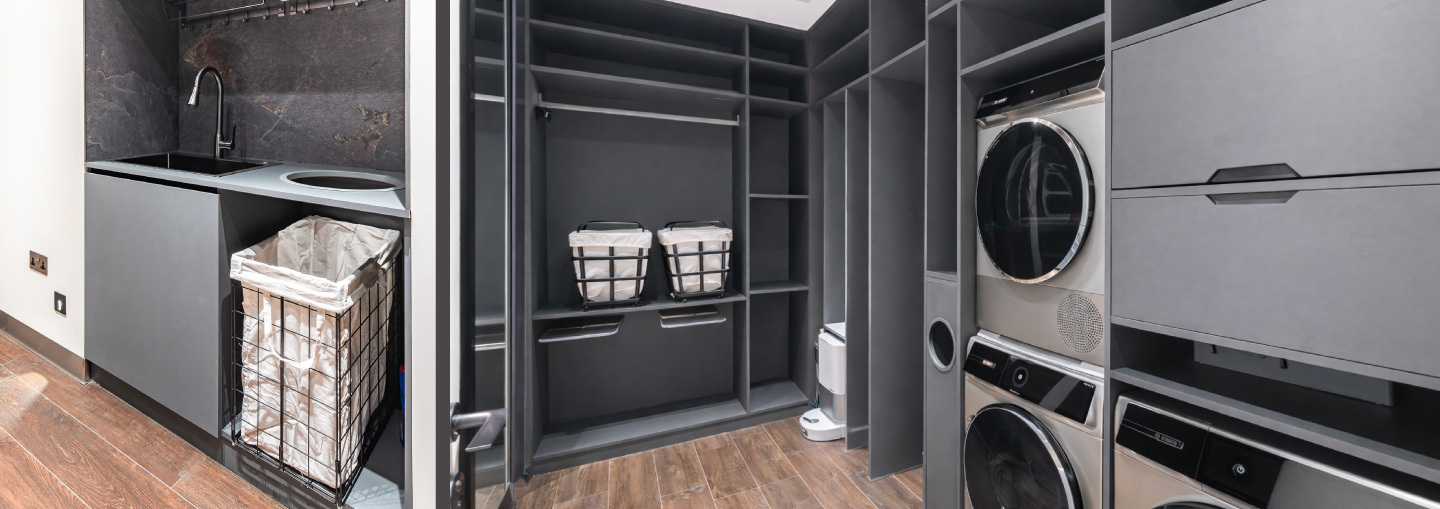
Laundry rooms rarely appear in architectural renderings. They sit behind doors, tucked beside kitchens, hidden along corridors, or compressed into secondary service zones. Yet the irony is simple: few spaces are used as consistently.
The best laundry room design ideas begin with that recognition. A utility space is not secondary simply because it is practical. It is part of the daily rhythm of a home, and when designed intentionally, it can feel composed rather than improvised.
A well-designed laundry room balances workflow, storage, durability, and visual coherence. When those elements align, even a compact footprint can feel deliberate.
Rethinking the Purpose of a Utility Room
A functional utility room design is not defined by appliances alone. It is defined by how movement unfolds inside it.
Laundry involves stages: sorting, washing, drying, folding, storing. When layout planning respects that sequence, friction disappears. When it does not, the space feels crowded regardless of size.
Many modern laundry room design concepts treat the room as a compact workstation. Surfaces are continuous. Storage is vertical. Lighting is layered. There is a sense that every centimeter was considered.
This shift is subtle but important. The room no longer feels like an afterthought. It feels planned.
Laundry Room Layout Planning That Supports Workflow
Laundry room layout planning should begin with adjacency and clearance, not decoration.
Side-by-side machines allow for a continuous folding surface above. Stacked units free up lateral space but demand vertical storage strategy. In narrower footprints, alignment becomes critical.
A clear layout often follows a simple principle: movement should be logical and uninterrupted.
In practice, that means:
-
- Sorting surfaces positioned near the entry
-
- Machines placed with sufficient clearance for doors and ventilation
-
- Folding zones directly adjacent to dryers
- Storage integrated within arm’s reach
These decisions are not dramatic. They are structural. And structure defines comfort.
When small laundry room ideas focus first on circulation, even compact areas feel efficient rather than constrained.
Built-In Cabinetry for Laundry Rooms: Quiet Structure
Built-in cabinetry for laundry rooms does more than hide supplies. It establishes architectural order.
Custom millwork in laundry rooms introduces rhythm. Vertical divisions align with appliances. Upper cabinets extend sightlines. Open shelving, when used sparingly, breaks density without introducing clutter.
Manufacturers and custom furniture brands such as Yanetti Furniture often approach utility spaces with the same attention given to kitchens or wardrobes. The emphasis is on proportion, finish quality, and long-term durability rather than decorative excess.
In higher-end homes, cabinetry often mirrors adjacent kitchen finishes. In more modest projects, painted MDF or laminate panels can achieve the same compositional effect.
The important detail is cohesion.
Laundry room storage solutions work best when concealed systems dominate visual space. Brooms, detergents, baskets, and spare linens disappear behind flush panels. The result feels calmer.
A composed room feels intentional, even when the function remains purely practical.
Small Laundry Room Ideas That Expand Perception
Scale is rarely the real limitation. Perception is.
Small laundry room ideas succeed when they manage visual weight carefully. Light cabinetry reflects brightness. Continuous countertops reduce fragmentation. Vertical storage pulls the eye upward.
In narrow layouts, designers often eliminate upper cabinets on one wall and replace them with open rails or shallow shelving. This reduces enclosure while maintaining function.
Mirrors are rarely necessary. Instead, material continuity performs the same task.
A single flooring material that matches adjacent spaces prevents the room from feeling isolated. A neutral palette avoids visual compression. Subtle contrast in hardware or lighting adds refinement without overwhelming the footprint.
When space is limited, restraint becomes the strongest design tool.
Laundry Room Lighting Ideas That Change the Mood
Lighting is often underestimated in utility zones.
Yet laundry room lighting ideas directly influence how the space feels. Overhead fixtures alone produce shadows and flatten surfaces. Layered lighting introduces clarity.
A balanced scheme typically includes:
-
-
- Under-cabinet lighting for task surfaces
- Accent lighting near shelving or millwork
- Recessed ceiling lights for general illumination
-
Cool white tones emphasize cleanliness, but excessively harsh light can feel clinical. Many designers now favor neutral white ranges that maintain clarity without starkness.
In modern laundry room design, lighting becomes architectural. Integrated LED strips hidden within cabinetry elevate the room subtly. The space feels considered rather than improvised.
Light defines atmosphere. Even in a service room.
Materials That Withstand Daily Use
Durability is not optional in a laundry room. It is foundational.
Countertops should resist moisture and detergents. Quartz performs well due to its low porosity. Porcelain slabs offer similar resilience with a more tactile finish. Laminate remains a practical choice when installed properly.
Flooring demands equal attention. Porcelain tile remains common because it tolerates spills and temperature fluctuations. Luxury vinyl planks are increasingly used in residential projects for their water resistance and warmth underfoot.
Cabinet finishes should be easy to clean. Matte surfaces hide fingerprints better than gloss. Handles should feel solid, not decorative.
Furniture makers who specialize in tailored interiors, including Yanetti Furniture, typically emphasize construction integrity in high-use spaces. Joinery quality, moisture-resistant boards, and precision installation all contribute to longevity.
Material selection is not aesthetic alone. It is strategic.
Storage Systems That Anticipate Use
Laundry room storage solutions often fail when they rely only on shelves.
Intentional design anticipates behavior. Pull-out hampers reduce visual clutter. Vertical compartments accommodate ironing boards. Slim cabinets house cleaning tools. Deep drawers organize folded linens more effectively than open baskets.
Open shelving works best when curated. Excessive visibility creates visual noise.
In custom millwork in laundry rooms, adjustable interior shelving allows for flexibility over time. Household needs evolve. Storage should adapt.
When systems anticipate use, maintenance becomes easier. The room feels controlled rather than chaotic.
The Role of Aesthetic Continuity
Modern laundry room design increasingly aligns with the broader architectural language of the home.
In open-plan houses, utility spaces are no longer hidden behind service corridors. They may sit near kitchens, mudrooms, or transitional areas. Visual continuity matters.
Cabinet profiles, hardware finishes, and color palettes often echo adjacent rooms. This approach avoids abrupt stylistic shifts. The laundry room feels integrated.
Even subtle elements, such as matching skirting boards or consistent wall paint, reinforce this connection.
Intentional design is rarely about extravagance. It is about coherence.
Psychological Impact of Intentional Utility Spaces
There is a quiet psychological effect in well-designed functional rooms.
Spaces that feel organized reduce cognitive load. When surfaces are clear and storage is defined, tasks feel manageable. Clutter, by contrast, amplifies stress.
Laundry is repetitive. Design cannot remove repetition, but it can reduce friction.
Many homeowners are surprised to discover how much calmer daily routines feel once a utility room is reorganized architecturally rather than cosmetically.
This is where thoughtful laundry room design ideas reveal their long-term value. They support daily life without drawing attention to themselves.
Designing for Longevity, Not Trends
Trends move quickly. Utility spaces should not.
Timeless materials, restrained palettes, and logical layout planning endure. Bold wallpaper or statement tile can add character, but structure should remain grounded in practicality.
Functional utility room design is most successful when it avoids novelty for its own sake.
A neutral base allows smaller details to evolve. Hardware can change. Lighting fixtures can update. Cabinet interiors can be reconfigured.
The framework remains stable.
When Utility Becomes Intentional Architecture
A laundry room does not require luxury to feel intentional. It requires thought.
Clear layout planning, integrated storage, durable materials, and balanced lighting transform the experience of use. What was once hidden becomes quietly composed.
Laundry room design ideas are no longer about concealment. They are about clarity.
In contemporary homes, even the most practical spaces deserve architectural attention. When utility rooms are treated as part of the design conversation rather than separate from it, the result is subtle but unmistakable.
The space feels finished.