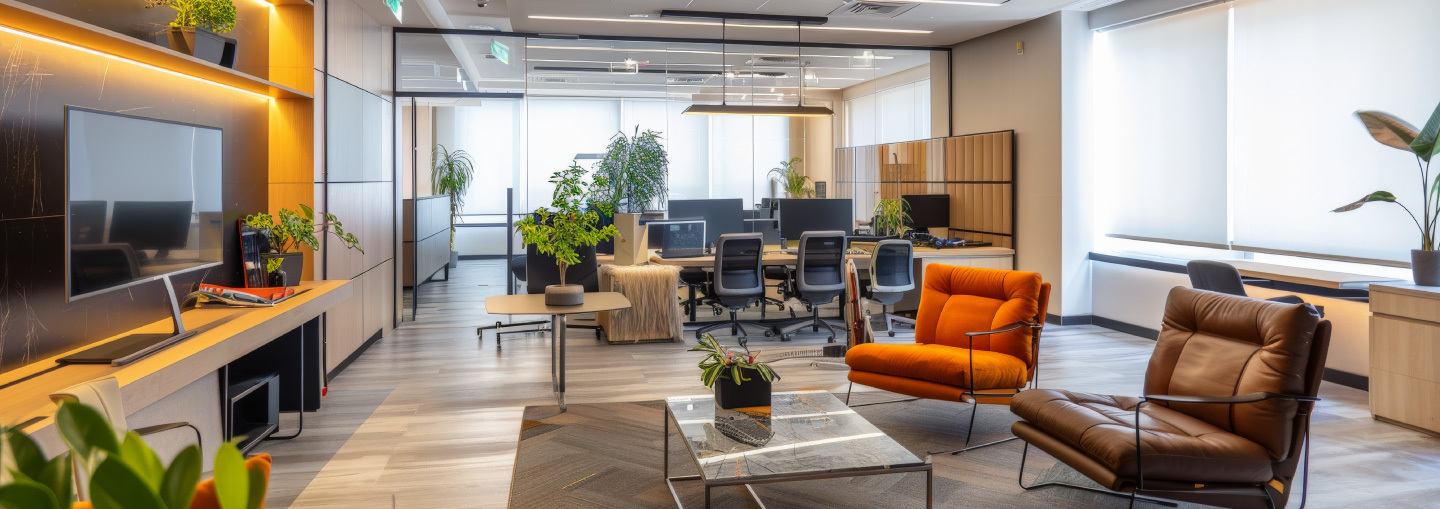
There was a time when corporate offices felt permanent.
Long runs of identical desks, overhead lighting that never changed, chairs lined up like they were issued in bulk. It worked, at least on paper. Everyone had a place. Everything stayed put.
That version of the office is fading.
By 2026, the conversation around corporate office furniture is noticeably different. Not louder, not trendier, just more practical. Companies are not asking how to make a space impressive. They are asking how to make it adaptable.
And furniture sits at the center of that shift.
The Workstation Is No Longer Sacred
Hybrid work did not eliminate the office. It quietly changed its priorities.
Occupancy data from corporate real estate reports shows that most offices operate well below full capacity on any given day. Desks are empty more often than they are occupied. That simple fact forces a rethink.
When people are not present five days a week, assigning a permanent workstation to each employee stops making sense.
Instead of building around ownership, companies are building around availability.
This sounds subtle, but it affects everything:
- Storage moves away from the desk
- Cable systems are simplified
- Surfaces are designed for turnover, not personalization
The workstation becomes temporary by design.
Many organizations are also reducing the physical footprint of desks. Bench systems are shorter. Touchdown tables appear near circulation zones. Private focus rooms replace some rows of open seating.
The office begins to feel less territorial and more fluid.
Not chaotic, just less fixed.
Ergonomics Expands Beyond the Chair
For years, ergonomic investment meant upgrading task seating. Adjustable arms, lumbar support, breathable mesh, problem solved.
The science, however, moved on.
Occupational health research consistently links prolonged static sitting with musculoskeletal strain and reduced metabolic activity. Even a well-designed chair does not offset the risk of staying still for hours.
That realization is reshaping procurement briefs.
In 2026, ergonomics is defined less by the chair and more by movement.
Sit-stand desks are no longer executive perks. They are increasingly standard specification. Monitor arms are expected, not optional. Informal seating that supports laptop work appears throughout open areas.
The emphasis is variability.
A well-designed workspace now allows posture changes throughout the day without drawing attention to them. Leaning stools. High counters. Softer collaborative seating. None of it dramatic. All of it intentional.
There is also a quieter development underway. Ergonomics now includes cognitive comfort. Glare control, background noise moderation, and visual shielding are treated as health considerations rather than aesthetic details.
The body is not the only system that needs support. Focus does too.
Modularity Replaces Permanence
Corporate structures change faster than custom-made furniture used to.
Departments expand, contract, merge. Teams form around projects and dissolve six months later. Real estate commitments are shorter. Headcounts fluctuate.
Fixed furniture layouts struggle to keep up.
Instead of continuous built-in desks, companies are specifying components that detach and reconfigure. Worktables can convert into meeting surfaces. Storage elements double as low partitions. Acoustic screens clip on and off.
The guiding idea is simple: furniture should not outlast the organizational chart.
This is not about minimalism. It is about reducing friction when change happens.
Facilities teams increasingly calculate reconfiguration time as part of cost analysis. A layout that can shift over a weekend, without external contractors, holds measurable value.
Flexibility is no longer aesthetic language. It is operational efficiency.